
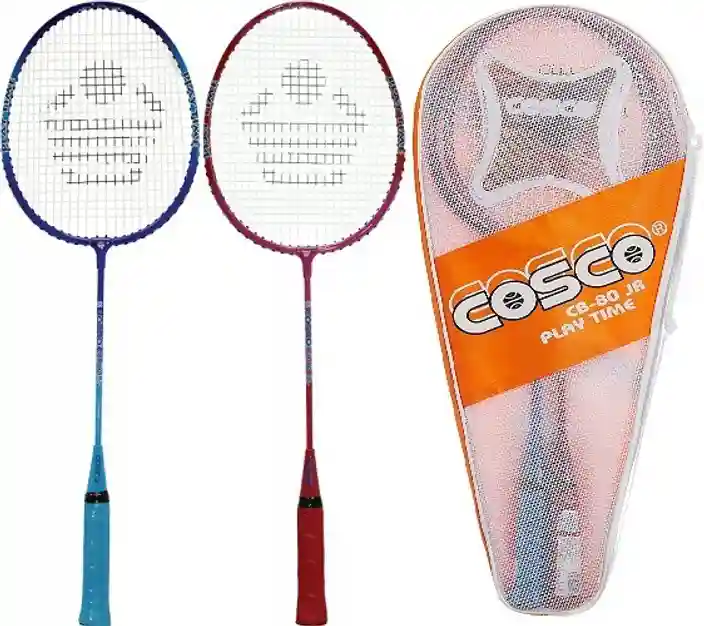
In a sport dominated by big names like Yonex, Victor, and Li-Ning, it’s easy to overlook brands like Cosco—especially in the world of badminton. But sometimes, the most unassuming choices turn out to be the most practical, especially when you’re starting out or playing for the sheer joy of the game. And that’s where the Cosco CB80 comes in—affordable, simple, and surprisingly effective.
This blog isn’t going to shower the CB80 with glitter and gold. That’s not the point. This is about telling the real story of a racket that delivers way more than it promises. Whether you’re a student looking for a budget-friendly option or someone who plays for fun in the evenings, the CB80 has something valuable to offer.
First Impressions: What the CB80 Looks and Feels Like
At first glance, the Cosco CB80 looks fairly minimalistic. No flashy decals or bold fonts screaming “Pro-Level Weapon.” It’s the sort of racket you might walk past in a sports store without giving it a second thought. But once you hold it, things change.
The CB80 feels surprisingly balanced in the hand. It has a lightweight aluminum frame, but it doesn’t feel like one of those cheap knock-off rackets that bend with a breeze. There’s a certain sturdiness to it—solid, reliable, without being bulky.
When I picked it up for the first time, I thought, “Okay, this might actually be decent.” It didn’t wow me, but it didn’t disappoint either—and that neutrality is underrated. Sometimes, all you need is a racket that won’t fight back.
Build Quality: More Than Just Budget-Friendly
Let’s face it: if you’re picking up the CB80, you’re not expecting carbon fiber precision or nano-tech graphite engineering. But what it offers is consistency. The aluminum frame is reinforced just enough to endure moderate force, which makes it ideal for school matches, beginners, and recreational players.
The shaft is made of tempered steel—slightly stiffer than some may expect, but not unmanageable. That stiffness actually works in favor of players who are still developing control and technique. It keeps your shots straight and limits too much flex, which can often throw off new players who haven’t mastered their wrist movement yet.
I’ve had rackets in the same price range that literally broke after three rallies. The CB80? It just keeps going. It’s not invincible, of course, but unless you’re spiking smashes like Lin Dan, this racket will serve you well for a long time.
Performance on the Court: Honest and Straightforward
So, how does the Cosco CB80 perform when it really matters—on the court? Let’s break it down into parts: smashes, clears, drops, and net play.
Smashes
Smashing with the CB80 won’t make your opponents dive in panic. It’s not a racket built for power; it’s built for reliability. That said, you can still get a decent punch if you’ve got the technique. The stiff shaft helps channel energy well, but since the head is evenly balanced and not heavy, you won’t get that extra weight helping with momentum.
Still, during casual games, I found my smashes hitting their mark more often than not. It’s all about timing with this racket. You won’t overpower anyone—but you can outsmart them.
Clears
Now this is where the CB80 shines. Overhead clears feel very controlled. Even with a medium grip and minimal wrist flick, you can get the shuttle comfortably to the backcourt. That’s thanks to the evenly balanced frame and shaft rigidity. I was genuinely surprised by how effortless it felt to reset a rally with a high, deep clear.
This makes it especially beginner-friendly, because many entry-level players struggle to get the shuttle deep without overexerting themselves. The CB80 gives you that control without needing professional-level technique.
Drop Shots
Drop shots are decent—not razor sharp, but dependable. I wouldn’t say this racket is designed for finesse at the net, but if your technique is decent, it won’t get in your way. You’ll find the shuttle responds predictably, which is honestly a blessing when you’re learning the ropes of deceptive net play.
Net Play
This racket isn’t featherlight, but it isn’t clunky either. At the net, you can get decent reaction speed, though it might feel a touch slow compared to ultralight graphite rackets. Still, when playing doubles at a local club or with friends, I found I could intercept smashes and push the shuttle over the net without feeling overwhelmed.
Durability: Tougher Than It Looks
Now, this is where the CB80 truly punches above its weight. One of the best parts of this racket is how durable it is for its price. It can take a beating—not just during rallies but also the accidental knocks against walls, shoes, or even the occasional wild swing from a doubles partner.
The steel shaft and aluminum frame can handle more mishandling than most beginner rackets. The strings are basic nylon but don’t fray as easily as I feared. I’ve played with mine regularly for over four months, and while I can feel the tension loosening, it’s still very playable.
For school kids, hostel students, or casual players who don’t have the time or resources to restring often, this reliability is gold.
Who Is the CB80 For?
If you’re reading this and wondering if the Cosco CB80 is the right fit for you, here’s a quick breakdown:
- Beginners: Absolutely. This racket is ideal for someone just stepping into the world of badminton.
- School/College Players: Perfect for inter-house or intramural games.
- Casual Weekend Warriors: Great if you just play with friends or family and don’t want to splurge.
- Intermediate Players? Maybe not. If you’ve developed your game and are looking for more speed or customization, you might outgrow this racket.
- Kids and Teenagers: Yes, because of its forgiving nature and durable build.
What Makes It Special?
You might still be wondering—why talk so much about a basic racket? What makes the Cosco CB80 worth 2000 words?
Because it fills a very real gap. Not everyone can afford a Rs. 5,000 or Rs. 10,000 racket. And not everyone needs one. There’s a whole segment of players—school kids, college students, hobbyists—who just want something that works, that feels good in the hand, and doesn’t give up after a week. The CB80 is for them.
It doesn’t try to be something it’s not. There’s a raw honesty to this racket that’s hard to find in today’s overly commercialized gear market. In an era of marketing gimmicks and unnecessary jargon, this simple racket just does its job.
Things That Could Be Better
Of course, it’s not all sunshine. Here are a few points where the CB80 shows its limitations:
- Grip Quality: The stock grip is pretty average. You’ll likely want to replace it with a cushioned overgrip or towel grip for better comfort.
- String Tension: Factory tension is low. It’s playable, but if you’ve played before, you might find the response too soft.
- Weight Distribution: While the balance is even, it doesn’t lend itself to fast wrist action or deceptive play.
- Lack of Branding Appeal: For players who care about the “cool factor,” this won’t stand out.
But again, considering the price point, these are nitpicks more than real complaints.
Personal Story: From Skeptic to Fan
Let me wrap this up with a personal anecdote. A few years ago, I visited a friend’s hometown during the holidays. We didn’t have any rackets with us, so we popped into a small local sports shop and found two Cosco CB80s hanging on a rack for under ₹600 each.
I laughed. “These are going to snap in five minutes,” I said.
But we played for days. Morning to evening. Under the sun. On rough cemented courts. The shuttles took a beating. We took a beating. And the CB80s? They never broke. They didn’t even flinch. I still have that racket. It’s worn, scratched, but still hits straight.
Sometimes, performance isn’t about power or precision. It’s about lasting memories. And the CB80 gave me plenty.
Final Verdict: The People’s Racket
If you’re looking for fancy, flashy, or featherlight, the Cosco CB80 isn’t for you. But if you’re after value, durability, and honest performance—something that gets the job done without fuss—then this racket is a quiet champion.
It may not make you the next world champion, but it’ll make you love the game. And at the end of the day, isn’t that what a good racket is supposed to do?




Leave a Reply